Enslaved has ceased to be the black metal beast it once was for a very long time. With an increasing amount of folk influence in their once more progressive music, it comes as no surprise that Enslaved would embrace one of the most authentic Norwegian folk adjacent outfits out there.
Storm Weather Shanty Choir strikes me as among the initiated, after all, they have the sense to describe themselves in their spotify bio as “rockers” singing Shanties as opposed to aligning themselves outright with Metal. Their dark, slightly somber shanties are spiritually aligned with the music of Enslaved.
What we have is a creative and innovative collab, with the first track receiving the stamp of Enslaved and being transformed from both its original format and from the typical music as Enslaved while not going too far off the mark. In short, the essence of “natural progression”. The second track is more clearly the work of the Storm Weather Shanty Choir but there are some musical nodes that bleed Enslaved. Both of the tracks are so unique I guarantee you if you compared them to every other cover of Fire Morengo and Anna Lovinda, you would be able to pick these out in a crowd. And that is what makes a good cover, this imprinting with your own musical stamp.
If Enslaved continues dropping a single every year or so, and deliver this caliber of song consistently, I for one am okay with that sort of output. Because this content is familiar enough not to be jarring, and new enough to not to be alienating. And the two artists coming together is the collaboration nobody knew they wanted, and I’m sure now that the waters have been braved – we will, in fact, be wanting more.
I would recommend this song to fans of any sort of folk music, as well as fans of Enslaved and Storm Weather Shanty choir. This isn’t a release that has a niche in the existing audience.
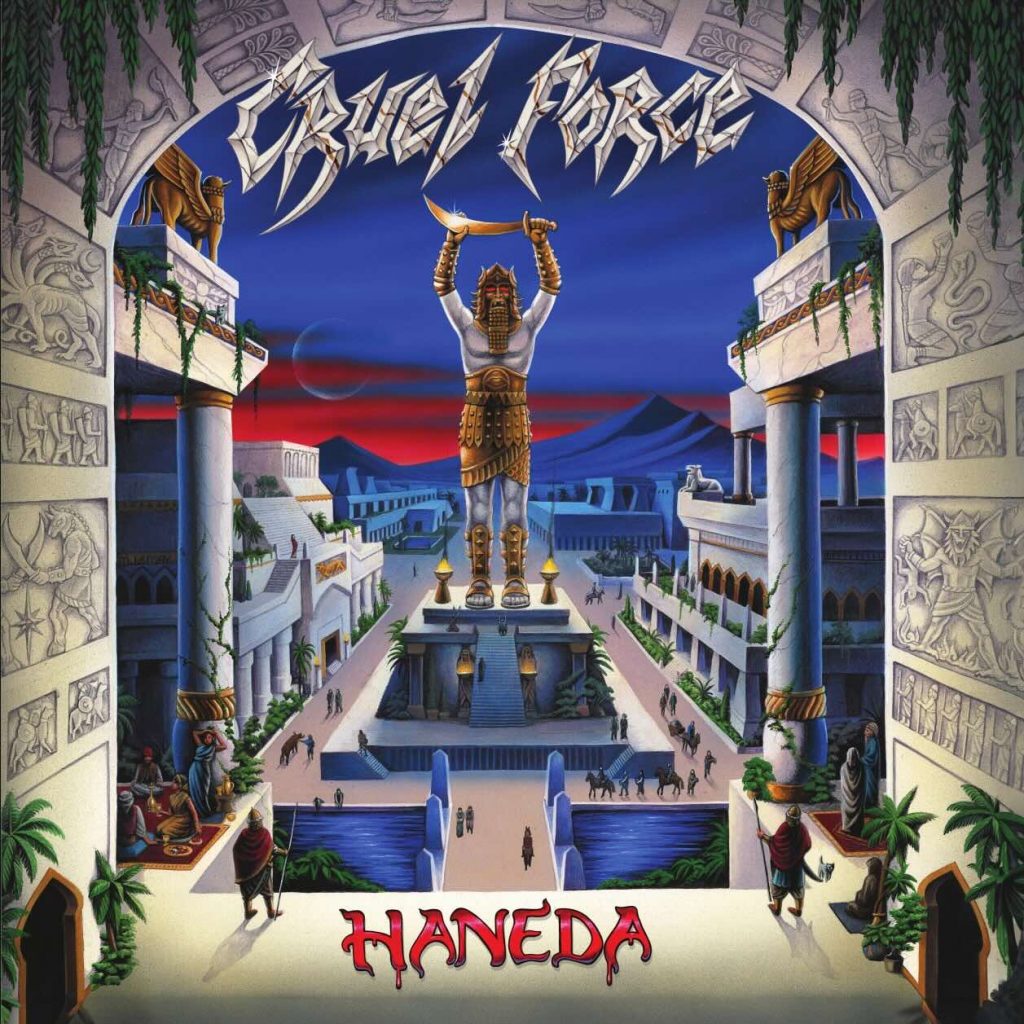
Readers who have read my last review will know my opinion on the tendency to make imaginary EPs to justify playing the algorithm. But honestly, if Cruel Force picked the right songs, the EP would have been better than this album. Does that sound harsh? Let me explain.
So called “New Wav of Traditional Heavy Metal” bands have an unfortunate tendency to play derivative music. Not always, but the tendency is there. And of course it is, while NWOBHM was innovation that arguably saved the floundering and ill-defined Metal microgenre, NWOTHM are the younger imitators of “Old School Metal”. Orcus may upset some people with this, but creative, competent bands like Grand Magus should not be listed on the Wikipedia article for NWOTHM because they predate the proper dating for the movement, and play a sound closer to Doom than “True” traditional heavy metal would be. Orcus the Vile likes creativity and has been put off by the generic high speed arpeggios and glorified picking exercises of the neo-speed Metal bands of old.
Cruel Force however, I like. I enjoyed their debut Rise of Satanic Might. So why, in the deeps of the seven hells is there even more generic neo-speed plodding here than on Dawn of the Axe? When a band departs from an old style, it is normal for there to be hiccups. After all, an artist needs to refine their craft. But somehow, this album is repetitive, formulaic, and mixed like the BP Oil spill (that was long ago you say? Sorry, after a few centuries, a few decades feel trifling). The bass is barely audible, and even the keyboards that is rightly reserved for ornamentation are more audible. It’s not all bad though, there are about four stand out tracks on this album that in some way break the formula or set themselves apart. Two of these songs, warlords and savage gods, were on the EP single already. If you include the other two (Sword of Iron, and Titan’s awakening) on the EP instead, you would save the listener’s time (because unfortunately, this album does drag), and focus on quality over quantity.
Excluding the intro, we have heard half of this album already. And while this music is exciting has some mindless beats you can mosh and headbang to, it lacks substance. And let me address anybody who defends this album as an underrated gem, because I have seen the fans of Cruel Force around: the head banging is fun, but when is the next time this album will be your first choice to listen to for pleasure unrelated to the activity that accompanies it? And when will it be your second choice? Now when what are the odds you will listen to it again in its entirety when not in a playlist or a comp?
Honesty hurts, and with that let me give some more positives. Aside from being decent party music, the lyrics have more ambition than they have any right being. A lot of it actually hits home. I will be shouting some of these songs in the shower if the mood strikes me. And as long as something sticks, I say embrace it.
This album is for the party crowd and for the people who ride or die by the new wave of traditional heavy metal. It’s an ambitious release, and if you can be bothered to listen for 42 minutes and just want some blazing riffs to unwind to, this album will be for you.
Iron Savior has not been on my radar until very recently. Their science fiction concept albums and intense vein of Power Metal helps set them apart from the more watery europower that is so common throughout the continent. It makes sense, Iron Savior is from the old guard of European Power Metal, back when the sound still packed a decent bodyshot with minimal wind-up. But this cover album, even to an outsider, will seem a little out of place coming from a Metal band. And that may be true, but Iron Savior began as a cover band in a high school talent contest, and most every release featured at least one cover. It is not the covers that are out of place here, it is rather the presence of a slurry of europop with otherwise little originality with which Iron Savior can put their stamp on it that drags this album down.
Lets start with the positive, because this album isn’t all bad, the production is phenomenal. Piet Sielck prides himself as a producer, and we definitely see those talents here. And while the lyrics to the songs themselves are basically the catchy, if a little shallow pop you would expect, Piet does deliver them with conviction and passion. If it were not for the delivery Orcus’s whiskered snout may pick up the distinct stench of greed and deceit. And take it from Orcus the Vile, you would need an act of sorcery to determine if this album is selling-out, and unfortunately it is not worth the material cost to do so (besides, where would I find a piece of quartz with a preserved optic nerve within it on such short notice?).
What you do not need sorcery to read is the omens here. And there are a few even to the untrained eye. Consider – there official discography of Iron Savior lists their most recent single as just one song – but with all four singles released, their most recent single is actually labelled as an EP. And that is the giveaway. Only the more aware bands bother calling their combined, streaming optimized singles EPs because they recognize 4 tracks is technically an EP and not a single. And even fewer bands have the sense to actually release their last single as an official EP to distract from the fact that they are playing the algorithm on spotify like some common garage rapper.
Does Orcus sound elitist? Well I should not be sounding elitist. An elitist would refuse to behead his enemies without a two-body katana from the Edo period. Orcus the Vile only uses halberds looted from the bodies of European palace guards – he is not elitist, he merely has standards. Playing the algorithm, for example, is a standard the trendies hold themselves too. But the imaginary releases is but the first omen.
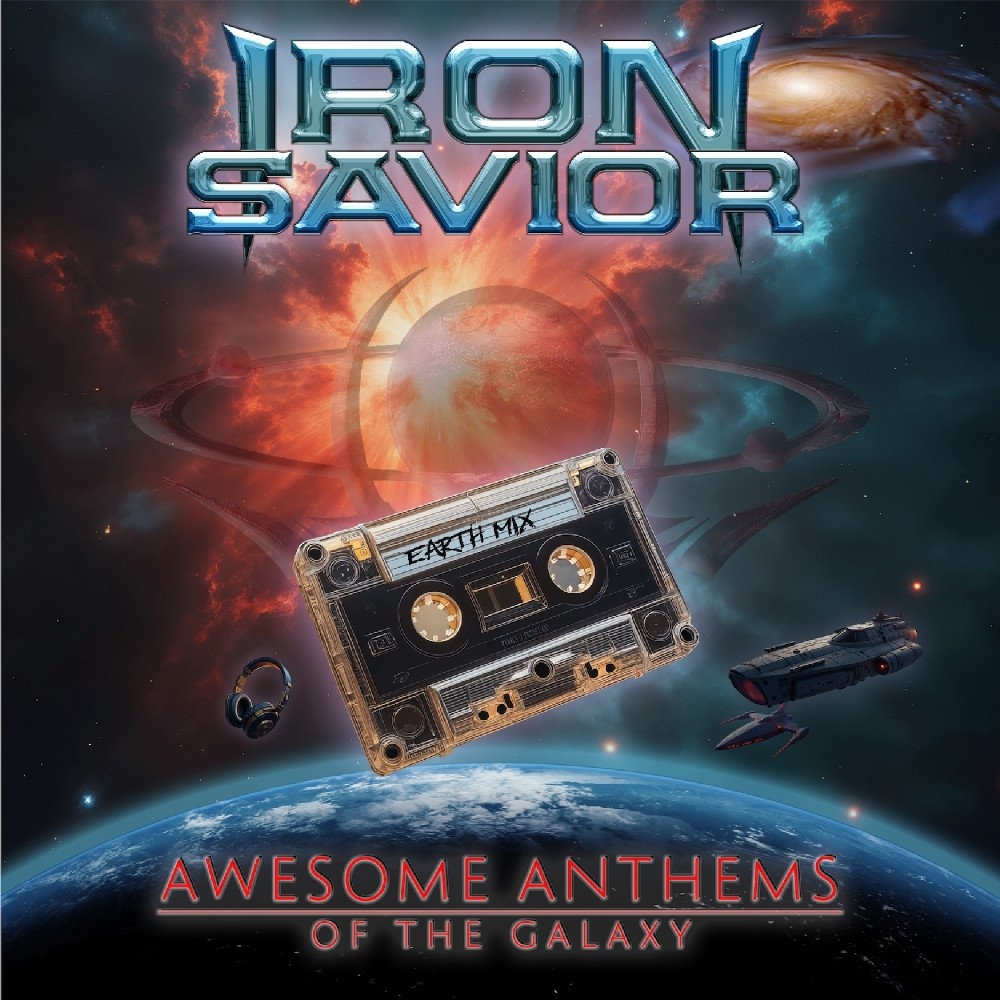
The bigger problem here is the cassette on the cover. Though it does make sense in a clever sort of way in that it is a mix that flies through space in Iron Savior’s little realm – are these tracks really the prime mix on a fictional earth where Metal is the force of nature? Does pop rule the airwaves in this Metal fantasy world? These are the questions we have to address if its taken with any seriousness fictionally, if not, it feels like Iron Savior is trying to reach new audiences with their banner of europop, and maybe even land a production deal with the artists that were so conveniently added in the metadata on spotify. However, giving the artists credit is the right thing to do, and Orcus does not want to be overly cynical.
Orcus is not overly familiar with the source work but there is a more than ninety percent chance that this release is too Metal for the pop crowd, and it is too poppy for all but the most devoted of Iron Savior’s fanbase. I hope to be doing a retrospective for Iron Savior’s early albums at some point as they are what inspired Orcus the Vile to go into space, with – mixed – results (lets just say the silicon valley engineers who “volunteered” to work at a deregulated compound ceased microdosing). Overall, since this album is as nonthreatening and accessible as they get I would heartily recommend it to the uninitiated. The music is a good compilation that showcases the musical talents of Iron Savior’s creative talent. For everybody else – stay tuned, we will revisit the Atlantean Warmachine soon enough.
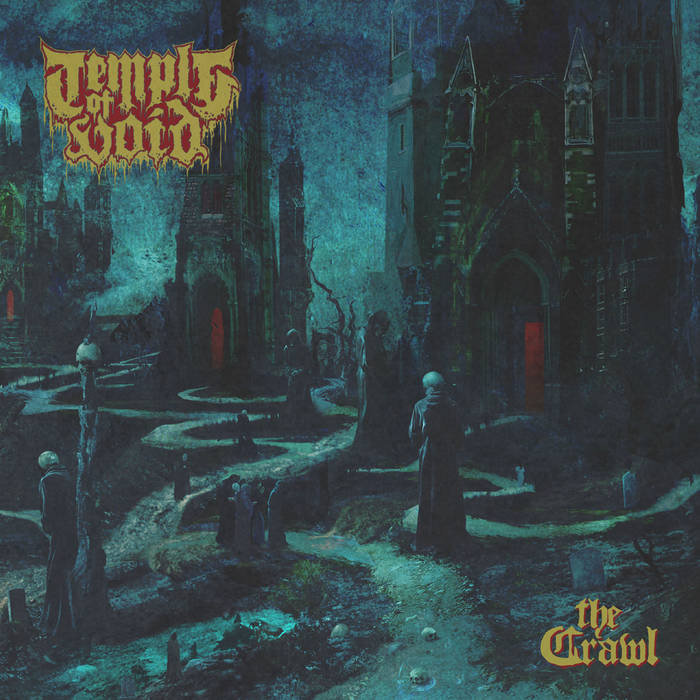
With an ominous atmosphere and creeping dread, The Crawl is perhaps the most appropriate title for this album. With one small exception though. Another worthy title would have been The Climb, because ToV sure do like their Phrygian mode. And if there is one thing on this release that can be called formulaic, it’s this Phrygian ladder in the solos that keeps popping up.
Orcus the Vile himself is not a fan of the sound, When last such an oriental lick repeated this much in under the span of an hour, I was paraded around the court of a sultan as a freak from the armies of Christendom. And Orcus the Vile is not an animal – the snout and tusks are genetic!
Personal gripes aside, the atmosphere definitely has a good feel. As hinted to in the start of this review, there definitely is a feeling of dread permeating the album. Expect there to be heavy riffs and echoing snarls as on many previous Temple of Void releases. There is more emphasis on death metal this time around, and I think it is a stretch to describe this as a Doom album musically, Slowing down music and adding fuzz does not Doom Metal make, the same as if Orcus fries chicken dry over a fire he does not suddenly have beef jerky – no matter what his acolytes say (Orcus the Vile has a high brow, not a sloping brow)!
Returning to the music, there is a decently heavy wall of sound, which augments the dark lyrical subject matter. The lyrics are once again bleak, and come in two categories: fantasy like “the crawl” or “poison mountain”, and personal struggles like “godless cynic”. There is a good spread of themes and influences in the lyrics and music respectively, and the album, even if formulaic at times – competently does what it sets out to do. I would recommend the Crawl as a better album to get into than Summoning the Slayer, but Orcus the Vile encourages listening to their debut first.
Version: Post-Mortem Apocalypse 12 inch vinyl 33.5rpm
Rating: 3.5/5
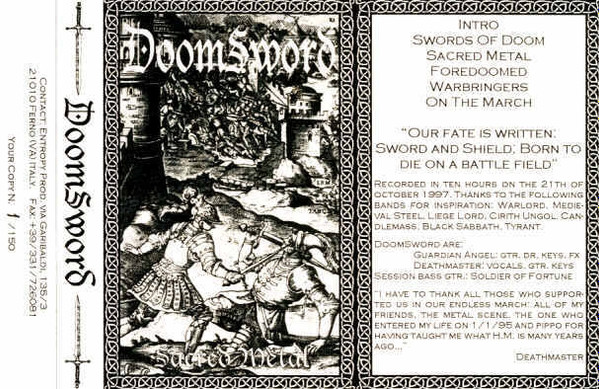
Ah yes Doomsword, one of the standard bearers of a certain vein of Doom Metal that crosses over into traditional heavy metal so potently that Manowar’s definition of True Metal seems outmoded. Other bands like Grand Magus that arguably also play this bottom-heavy vein of Heavy Metal do not cross over as effectively into Doom Metal as our Italian friends Doomsword. Although on this demo, they stay staunchly the ranks of Bathory and Manowar’s legions of followers, which was uncommon in an era where Rhapsody was all the rage. Sure, there are some moments of Doom and ominous interludes that show glimpses of where this band will go in the future, but most of this is a fairly standard banner for the adherents of True Metal to flock around.
I’m sure many who hung out amongst the Metal legions will be familiar with the obsessive history buffs who listen to Metal purely for the lyrics addressing the hyper focus they have. Sabaton’s mainstream fanboys come to mind, but there are many other bands with that sort of devotee. It may come as a surprise that Orcus the Vile initially approached Doomsword for a similar reason – but it is not because he is a history buff. Nay, Orcus enjoys the youth of today giving events from his early years the proper attention they deserve, and he finds their song Gergovia to be especially morbid. But we know they have lyrical brilliance, and they do transform the Doom they use as a foundation for their sound, so now we must address the elephant in the room. Why does this demo have only 3.5 stars?
Let us establish firstly, this is not the record label’s fault. Though the vinyl itself was a snug fit in the machine with bits of plastic left over, the vinyl was actually converted from a demo of a cassette that was produced on a four track analog recorder. Now for you younger scions of humanity, let me explain something, in case you don’t know how cassettes work. After a while the tape begins to wear out. The sound becomes thin and feeble. The sound quality diminishes. And with only 150 copies of the original Sacred Metal demo in circulation, this leaves us with a can of worms transferring it to vinyl. I fully understand why they used vinyl, and it is a very nice collectible, but Orcus the Vile buys physical media to listen to. And at that point, a CD might be better, because the quality unfortunately sounds a lot like what you expect a demo to sound like except a little weak. Although the rawness does have a certain charm that makes the NWOBHM tendencies on the second half of the album sound all the more endearing.
As mentioned in the intro, the album fits squarely in the ground of Manowar, Cirith Ungol, and even moments of Bathory’s Viking Metal era. We do see some moments of innovation, with a bleak and desolate atmosphere, and moments of overt doom in the intro and interlude. This atmosphere and the doom sensibilities will be the direction the band fundamentally take later, and it shows. That being said, sacred Metal has yet to find its own sound in the way the self-titled debut did later in 1999.
Considering what we see in the booklet, Sacred Metal used to be all Medieval music for a different project, but Deathmaster and Guardian Angel rearranged it quickly to meet a production deadline. I’d say with those constraints, it came out pretty well. The biggest triumph on this demo though, the one thing that showcases the grandeur of later Doomsword music well, is the lyrics.
Let it be known that Orcus the Vile is not opposed to holy wars, he ordered his legions on several (and they would have been successful too if our expeditionary force didn’t end up in Narnia instead due to a portal malfunction), so when he says unto the reader that he enjoys these lyrics – know Orcus does not jest. Yes, these lyrics deal with the penitence of two bards who go off to fight a holy war and meet their doom. The organization of the story is a little bit sloppy, with the timeline jumping between songs, but this isn’t Iron Savior, its young lads trying to play the music they like. And here is the ultimate virtue of this album.
Doomsword made this album to play the kind of music they want to hear, which was the kind that was not all that popular. They played the music with conviction and passion, and their love for the old guard of Metal shows in the unstable electric storm they harnessed in a bottle. It would not be harnessed and fielded. as lightning yet, but the potential is there in the bottle. And that is what this demo is. Potential in a bottle. And even if Orcus has ears everywhere, he would prefer electricity to sparks. But sometimes sparks hit the spot.