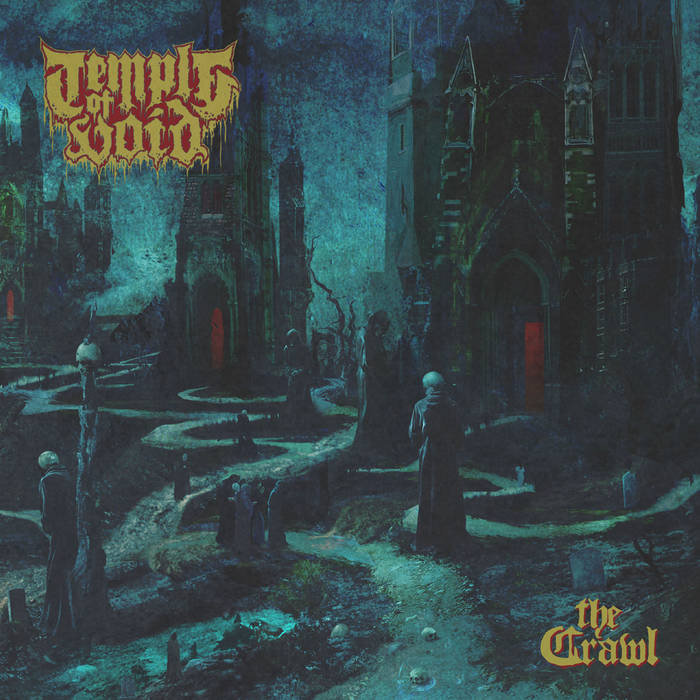
With an ominous atmosphere and creeping dread, The Crawl is perhaps the most appropriate title for this album. With one small exception though. Another worthy title would have been The Climb, because ToV sure do like their Phrygian mode. And if there is one thing on this release that can be called formulaic, it’s this Phrygian ladder in the solos that keeps popping up.
Orcus the Vile himself is not a fan of the sound, When last such an oriental lick repeated this much in under the span of an hour, I was paraded around the court of a sultan as a freak from the armies of Christendom. And Orcus the Vile is not an animal – the snout and tusks are genetic!
Personal gripes aside, the atmosphere definitely has a good feel. As hinted to in the start of this review, there definitely is a feeling of dread permeating the album. Expect there to be heavy riffs and echoing snarls as on many previous Temple of Void releases. There is more emphasis on death metal this time around, and I think it is a stretch to describe this as a Doom album musically, Slowing down music and adding fuzz does not Doom Metal make, the same as if Orcus fries chicken dry over a fire he does not suddenly have beef jerky – no matter what his acolytes say (Orcus the Vile has a high brow, not a sloping brow)!
Returning to the music, there is a decently heavy wall of sound, which augments the dark lyrical subject matter. The lyrics are once again bleak, and come in two categories: fantasy like “the crawl” or “poison mountain”, and personal struggles like “godless cynic”. There is a good spread of themes and influences in the lyrics and music respectively, and the album, even if formulaic at times – competently does what it sets out to do. I would recommend the Crawl as a better album to get into than Summoning the Slayer, but Orcus the Vile encourages listening to their debut first.
Version: Post-Mortem Apocalypse 12 inch vinyl 33.5rpm
Rating: 3.5/5
Ah yes Doomsword, one of the standard bearers of a certain vein of Doom Metal that crosses over into traditional heavy metal so potently that Manowar’s definition of True Metal seems outmoded. Other bands like Grand Magus that arguably also play this bottom-heavy vein of Heavy Metal do not cross over as effectively into Doom Metal as our Italian friends Doomsword. Although on this demo, they stay staunchly the ranks of Bathory and Manowar’s legions of followers, which was uncommon in an era where Rhapsody was all the rage. Sure, there are some moments of Doom and ominous interludes that show glimpses of where this band will go in the future, but most of this is a fairly standard banner for the adherents of True Metal to flock around.
I’m sure many who hung out amongst the Metal legions will be familiar with the obsessive history buffs who listen to Metal purely for the lyrics addressing the hyper focus they have. Sabaton’s mainstream fanboys come to mind, but there are many other bands with that sort of devotee. It may come as a surprise that Orcus the Vile initially approached Doomsword for a similar reason – but it is not because he is a history buff. Nay, Orcus enjoys the youth of today giving events from his early years the proper attention they deserve, and he finds their song Gergovia to be especially morbid. But we know they have lyrical brilliance, and they do transform the Doom they use as a foundation for their sound, so now we must address the elephant in the room. Why does this demo have only 3.5 stars?
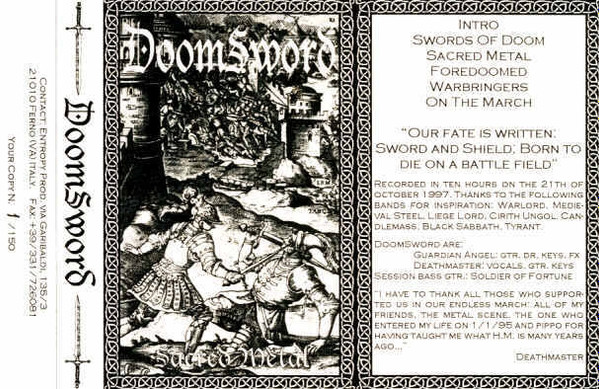
Let us establish firstly, this is not the record label’s fault. Though the vinyl itself was a snug fit in the machine with bits of plastic left over, the vinyl was actually converted from a demo of a cassette that was produced on a four track analog recorder. Now for you younger scions of humanity, let me explain something, in case you don’t know how cassettes work. After a while the tape begins to wear out. The sound becomes thin and feeble. The sound quality diminishes. And with only 150 copies of the original Sacred Metal demo in circulation, this leaves us with a can of worms transferring it to vinyl. I fully understand why they used vinyl, and it is a very nice collectible, but Orcus the Vile buys physical media to listen to. And at that point, a CD might be better, because the quality unfortunately sounds a lot like what you expect a demo to sound like except a little weak. Although the rawness does have a certain charm that makes the NWOBHM tendencies on the second half of the album sound all the more endearing.
As mentioned in the intro, the album fits squarely in the ground of Manowar, Cirith Ungol, and even moments of Bathory’s Viking Metal era. We do see some moments of innovation, with a bleak and desolate atmosphere, and moments of overt doom in the intro and interlude. This atmosphere and the doom sensibilities will be the direction the band fundamentally take later, and it shows. That being said, sacred Metal has yet to find its own sound in the way the self-titled debut did later in 1999.
Considering what we see in the booklet, Sacred Metal used to be all Medieval music for a different project, but Deathmaster and Guardian Angel rearranged it quickly to meet a production deadline. I’d say with those constraints, it came out pretty well. The biggest triumph on this demo though, the one thing that showcases the grandeur of later Doomsword music well, is the lyrics.
Let it be known that Orcus the Vile is not opposed to holy wars, he ordered his legions on several (and they would have been successful too if our expeditionary force didn’t end up in Narnia instead due to a portal malfunction), so when he says unto the reader that he enjoys these lyrics – know Orcus does not jest. Yes, these lyrics deal with the penitence of two bards who go off to fight a holy war and meet their doom. The organization of the story is a little bit sloppy, with the timeline jumping between songs, but this isn’t Iron Savior, its young lads trying to play the music they like. And here is the ultimate virtue of this album.
Doomsword made this album to play the kind of music they want to hear, which was the kind that was not all that popular. They played the music with conviction and passion, and their love for the old guard of Metal shows in the unstable electric storm they harnessed in a bottle. It would not be harnessed and fielded. as lightning yet, but the potential is there in the bottle. And that is what this demo is. Potential in a bottle. And even if Orcus has ears everywhere, he would prefer electricity to sparks. But sometimes sparks hit the spot.